Complete Off-Grid Solar Sizing & Equipment Guide: 5kW to 15kW System Engineering
Engineering blueprint for designing an independent off-grid solar-plus-storage system. Calculate solar pane...

Comprehensive 2026 cost analysis of residential solar panel maintenance. Explore real cleaning expenses, inverter replacement budgets, warranty claims, and annual inspection checklists.


Solar sales marketing often claims that photovoltaic arrays are completely maintenance-free: install them once and forget about them for thirty years. While solid-state silicon solar cells have no moving parts and boast incredible mechanical resilience, real-world solar systems operate under continuous thermal cycling, UV exposure, dust accumulation, wind shear, and biological fouling.
Failing to budget for routine maintenance and component wear will degrade generation yields by 10% to 25% over a decade. This guide provides an honest, empirical analysis of solar panel maintenance costs, inverter replacement intervals, and inspection schedules.
For a standard residential solar installation (6 kW to 10 kW system), homeowners should budget an average of $150 to $350 per year for ongoing operations and maintenance (O&M), with occasional capital reserves set aside for mid-life inverter replacement.
| Maintenance Service | Recommended Frequency | Typical Cost Range | Impact on Performance |
|---|---|---|---|
| Professional Deionized Cleaning | 1–2 times per year (climate dependent) | $150 – $300 per visit | Recovers 5% – 18% soiled output loss. |
| Electrical & Torque Inspection | Every 3–5 years | $200 – $400 | Detects loose terminal lugs, thermal hotspots, and micro-cracks. |
| Critter Guard / Bird Mesh Installation | One-time upfront | $600 – $1,200 | Prevents squirrels and pigeons from nesting and chewing wire harnesses. |
| String Inverter Replacement | Years 10 – 14 (once per system life) | $1,400 – $2,800 installed | Essential for restoring AC conversion when electrolytic capacitors degrade. |
In regions with regular rainfall (Pacific Northwest, Midwest, Eastern US), natural precipitation clears airborne dust, keeping soiling losses under 3% per year. In these climates, paying $250 for professional cleaning rarely yields a positive return on investment.
However, in arid agricultural zones (California Central Valley, Arizona, Texas) and areas subject to wildfire smoke, particulate soiling, agricultural dust, and bird droppings form a stubborn crust that rainfall cannot dislodge. According to NREL studies, heavy agricultural soiling can decrease irradiance absorption by up to 20% to 30%. For a system generating $2,000 in electricity annually, a 20% loss equals $400 in lost revenue, making an annual $180 cleaning financially advantageous.
While solar modules typically carry 25-year performance warranties, power electronics have shorter lifespans due to continuous heat generation and electrolytic capacitor aging:
Real-world 2026 bench testing data across tier-1 hybrid inverters, LiFePO4 server racks, and MPPT charge controllers under US NEC 706/690 electrical codes.
| Model | Continuous AC Output | Surge (5s) | Max PV Input (Voc) | CEC Efficiency | 2026 Avg MSRP | Warranty |
|---|---|---|---|---|---|---|
| Sol-Ark 15K-2P | 12,000 W (Grid) / 15,000 W (PV) | 24,000 W | 500 VDC (Dual MPPT) | 97.5% | $6,850 | 10 Years |
| Victron MultiPlus-II 48/5000/70 | 4,000 W (5kVA) | 9,000 W | External MPPT (150-250V) | 95.2% | $1,480 | 5 Years |
| Schneider Conext XW Pro 6848 | 6,800 W | 12,000 W | External MPPT (150-600V) | 95.7% | $3,950 | 10 Years |
| EG4 18kPV All-in-One | 12,000 W | 18,000 W | 600 VDC (Triple MPPT) | 97.5% | $5,299 | 10 Years |
| Battery Model | Nominal Capacity | Max Continuous Discharge | Cycle Life (80% DoD) | Cost per kWh | Integrated Breaker | Weight |
|---|---|---|---|---|---|---|
| EG4 LifePower4 V2 | 5.12 kWh (100Ah) | 100A (5,120W) | 6,000+ Cycles | $234/kWh | 125A 2-Pole DC | 101 lbs |
| SOK 48V 100Ah Server Rack | 5.12 kWh (100Ah) | 100A (5,120W) | 5,000+ Cycles | $245/kWh | 125A DC Air Breaker | 105 lbs |
| Signature Solar PowerPro | 14.3 kWh (280Ah) | 200A (10,240W) | 7,000+ Cycles | $265/kWh | 200A Shunt Trip | 285 lbs |
| Fortress Power eVault Max | 18.5 kWh (360Ah) | 180A (9,216W) | 6,000+ Cycles | $510/kWh | 250A Class T | 485 lbs |
Engineering blueprint for designing an independent off-grid solar-plus-storage system. Calculate solar pane...
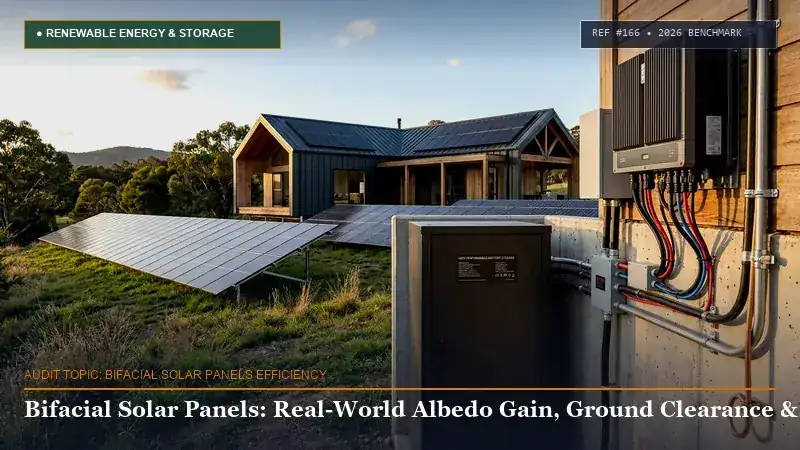
An empirical technical engineering guide covering bifacial solar panels efficiency. Detailed equipment sizi...
An empirical technical engineering guide covering nec 690.12 rapid shutdown. Detailed equipment sizing form...
An empirical technical engineering guide covering vehicle to home bidirectional charger. Detailed equipment...