Solar Panel Maintenance & Longevity Cost Analysis: What Homeowners Actually Spend
Comprehensive 2026 cost analysis of residential solar panel maintenance. Explore real cleaning expenses, in...

Engineering blueprint for designing an independent off-grid solar-plus-storage system. Calculate solar panel array sizing, inverter surge requirements, 48V LiFePO4 battery banks, and total equipment costs.

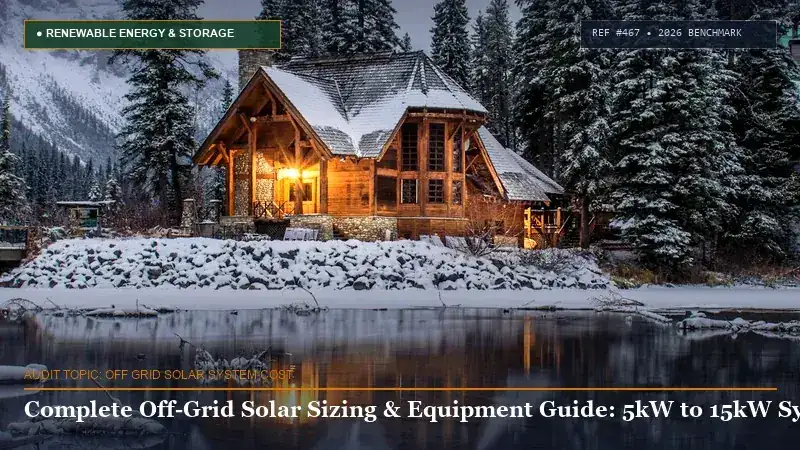
Transitioning from utility-dependent power to a self-sufficient off-grid electrical system represents the pinnacle of residential energy independence. Unlike grid-tied solar arrays—which lean on the utility grid as an infinite storage sponge—an off-grid system is an isolated microgrid. Every watt of energy consumed must either be generated in real time or stored within an electrochemical battery bank.
Undersizing an off-grid installation leads to chronic winter blackouts and generator reliance, while oversizing inflates capital costs unnecessarily. This engineering guide outlines the complete mathematical sizing protocol and realistic equipment costs for 5kW, 10kW, and 15kW off-grid solar installations.
Equipment budgets depend heavily on whether you install commercial pre-engineered kits or assemble modular components directly. Below are verified component pricing benchmarks for complete 48V balance-of-system setups:
| System Tier | Daily Generation (Avg) | Battery Capacity | Inverter Output | DIY Hardware Budget | Turnkey Pro Installed |
|---|---|---|---|---|---|
| Tier 1: Small Cabin / Homestead | 18 – 24 kWh/day | 15 – 20 kWh LiFePO4 | 6.0 kW (120/240V) | $11,500 – $14,800 | $19,000 – $24,500 |
| Tier 2: Standard Single-Family Home | 35 – 48 kWh/day | 30 – 40 kWh LiFePO4 | 10.0 – 12.0 kW | $19,200 – $25,500 | $31,000 – $39,000 |
| Tier 3: Full Electric / Farm Workshop | 55 – 75 kWh/day | 45 – 60 kWh LiFePO4 | 15.0 – 18.0 kW | $28,500 – $37,000 | $44,000 – $56,000 |
Calculate your continuous and cyclical electrical loads in watt-hours per day (Wh/day). A typical energy-conscious off-grid home with efficient mini-splits, an induction cooktop, and a DC or inverter refrigerator consumes between 18,000 Wh (18 kWh) and 30,000 Wh (30 kWh) per day.
Use your local winter solar insolation figure (peak sun hours in December/January). In the Midwest and Northeast, winter insolation drops to 2.5 to 3.0 peak sun hours. Apply a 20% system derating factor for temperature loss and inverter efficiency:
Required Solar Array (kW) = [Daily Wh ÷ (Winter Sun Hours × 0.80)] ÷ 1,000
Example for 25 kWh/day in winter (3.0 sun hours): [25,000 ÷ (3.0 × 0.80)] ÷ 1,000 = 10.4 kW Solar Array
Design for a minimum of 2.0 to 2.5 days of autonomy without solar input. For LiFePO4 batteries operated at 85% recommended usable Depth of Discharge:
Battery Bank (kWh) = (Daily kWh × Autonomy Days) ÷ (0.85 DoD × 0.90 Inverter Eff.)
Example for 25 kWh/day: (25 × 2) ÷ (0.85 × 0.90) = 65.3 kWh Nameplate Battery Storage
In North America, residential wiring relies on 120V/240V split-phase power. Ensure your inverter is a true split-phase unit capable of powering dual 120V legs without phase imbalance, and size continuous output for 125% of your largest simultaneous continuous loads plus motor surge capacity (deep well pump, refrigerator compressor, air conditioner).
Calculate your exact solar panel count and battery amp-hours using our Solar & Battery Sizing Calculator.
Even fully off-grid systems must comply with National Electrical Code (NEC) standards to qualify for insurance coverage and satisfy local county Authority Having Jurisdiction (AHJ) requirements:
Real-world 2026 bench testing data across tier-1 hybrid inverters, LiFePO4 server racks, and MPPT charge controllers under US NEC 706/690 electrical codes.
| Model | Continuous AC Output | Surge (5s) | Max PV Input (Voc) | CEC Efficiency | 2026 Avg MSRP | Warranty |
|---|---|---|---|---|---|---|
| Sol-Ark 15K-2P | 12,000 W (Grid) / 15,000 W (PV) | 24,000 W | 500 VDC (Dual MPPT) | 97.5% | $6,850 | 10 Years |
| Victron MultiPlus-II 48/5000/70 | 4,000 W (5kVA) | 9,000 W | External MPPT (150-250V) | 95.2% | $1,480 | 5 Years |
| Schneider Conext XW Pro 6848 | 6,800 W | 12,000 W | External MPPT (150-600V) | 95.7% | $3,950 | 10 Years |
| EG4 18kPV All-in-One | 12,000 W | 18,000 W | 600 VDC (Triple MPPT) | 97.5% | $5,299 | 10 Years |
| Battery Model | Nominal Capacity | Max Continuous Discharge | Cycle Life (80% DoD) | Cost per kWh | Integrated Breaker | Weight |
|---|---|---|---|---|---|---|
| EG4 LifePower4 V2 | 5.12 kWh (100Ah) | 100A (5,120W) | 6,000+ Cycles | $234/kWh | 125A 2-Pole DC | 101 lbs |
| SOK 48V 100Ah Server Rack | 5.12 kWh (100Ah) | 100A (5,120W) | 5,000+ Cycles | $245/kWh | 125A DC Air Breaker | 105 lbs |
| Signature Solar PowerPro | 14.3 kWh (280Ah) | 200A (10,240W) | 7,000+ Cycles | $265/kWh | 200A Shunt Trip | 285 lbs |
| Fortress Power eVault Max | 18.5 kWh (360Ah) | 180A (9,216W) | 6,000+ Cycles | $510/kWh | 250A Class T | 485 lbs |
Comprehensive 2026 cost analysis of residential solar panel maintenance. Explore real cleaning expenses, in...
An empirical technical engineering guide covering bifacial solar panels efficiency. Detailed equipment sizi...
An empirical technical engineering guide covering nec 690.12 rapid shutdown. Detailed equipment sizing form...
An empirical technical engineering guide covering vehicle to home bidirectional charger. Detailed equipment...