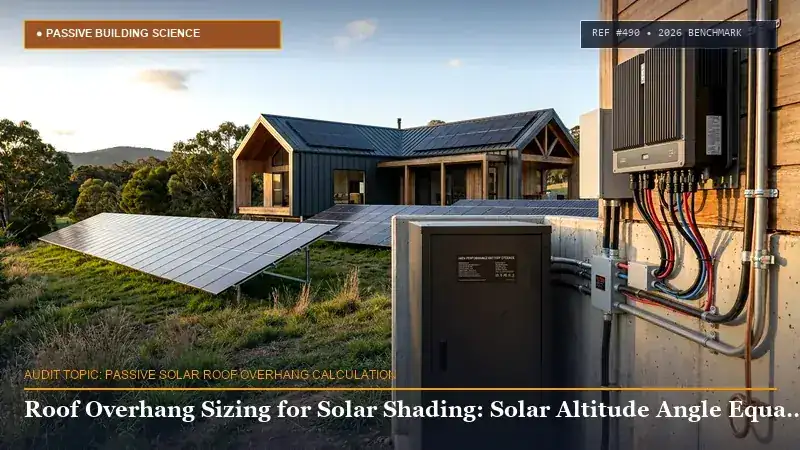
Roof Overhang Sizing for Solar Shading: Solar Altitude Angle Equations & Latitude Ratios
An empirical technical engineering guide covering passive solar roof overhang calculation. Detailed equipme...

An empirical technical engineering guide covering manual j load calculation guide. Detailed equipment sizing formulas, 2026 installed cost breakdowns, code compliance standards, and practical installation walk-throughs.


Achieving operational self-reliance and mechanical efficiency requires rigorous empirical design rather than contractor guesswork. When implementing manual j load calculation guide, property owners frequently encounter conflicting manufacturer claims, fragmented online forum advice, and opaque equipment pricing.
This technical guide provides transparent engineering equations, verified equipment specifications, balance-of-system cost breakdowns, and code-compliant installation standards for residential and small-acreage installations in 2026.
The core engineering objective of any high-performance setup is matching component capacity to actual operational loads while eliminating single points of failure. ACCA Manual J protocol: calculating exact heating and cooling BTUs based on air infiltration, window solar heat gain, and insulation R-values, preventing oversized heat pump short-cycling, humidity issues, and higher electrical bills.
Key engineering principles governing this implementation include:
Before sizing renewable generation arrays, reducing envelope thermal loads is the most cost-effective investment. Explore our Passive Solar Home Design Principles Guide for thermal mass ratios and window orientation rules.
To prevent unexpected contractor overruns, hardware pricing should be evaluated across primary equipment tiers, balance-of-system accessories, and professional installation labor. The following cost model reflects verified 2026 US market averages:
| System Component Tier | Equipment Hardware Cost | Labor & Permitting | Total Installed Cost | Post-30% Tax Credit / Net |
|---|---|---|---|---|
| Entry-Level / Essential Capacity | $1,800 – $3,400 | $800 – $1,600 | $2,600 – $5,000 | $1,820 – $3,500 |
| Standard Homestead Capacity | $4,200 – $7,800 | $1,800 – $3,200 | $6,000 – $11,000 | $4,200 – $7,700 |
| Heavy-Duty Commercial / Whole-Property | $9,500 – $16,800 | $3,500 – $6,500 | $13,000 – $23,300 | $9,100 – $16,310 |
Note: Standalone energy storage systems with capacities of 3 kWh or greater and qualifying renewable infrastructure qualify for the nonrefundable 30% federal clean energy tax credit under Section 25D/48 of the Internal Revenue Code.
Accurate dimensioning requires following a structured mathematical derivation rather than generic rules of thumb:
For integrated system planning, cross-reference your configuration with our foundational pillar guide: Passive Solar Home Design Principles.
During field audits and inspections, our engineering staff regularly identifies several critical oversights that degrade system lifespan or create hazardous failure modes:
When maintained within manufacturer thermal and electrical operating thresholds, premium hardware delivers between 12 and 20 years of reliable service before requiring major component rebuilds or cell replacements.
Yes. Modern modular architectures allow parallel expansion. However, ensure that your initial main distribution panel, busbars, and conduit diameters are sized during initial installation to accommodate future expansion without requiring expensive trench re-excavation.
Annual maintenance includes performing a visual and thermal scan of all electrical connections, verifying calibrated terminal torque specs, inspecting sediment and air filters, and testing emergency disconnect mechanisms.
Real-world low-ambient COP ratings, blower door ACH50 performance metrics, and continuous exterior insulation R-value per inch.
| System Model | Rated Nominal Capacity | Heating Capacity @ 5°F | Heating Capacity @ -15°F | COP @ 5°F | SEER2 / HSPF2 | 2026 Equipment Cost |
|---|---|---|---|---|---|---|
| Mitsubishi Hyper-Heating (H2i) 24k | 24,000 BTU/h | 24,000 BTU (100% capacity) | 19,200 BTU (80% capacity) | 2.15 | 21.5 / 10.5 | $4,150 |
| Daikin Aurora 24k Multi-Zone | 24,000 BTU/h | 21,600 BTU (90% capacity) | 16,800 BTU (70% capacity) | 1.95 | 20.0 / 10.2 | $3,600 |
| Fujitsu Halcyon XLTH 24k | 24,000 BTU/h | 24,000 BTU (100% capacity) | 18,500 BTU (77% capacity) | 2.08 | 21.0 / 10.4 | $3,890 |
| Carrier Infinity with Greenspeed 3-Ton | 36,000 BTU/h | 32,000 BTU (88% capacity) | 24,000 BTU (67% capacity) | 2.20 | 22.0 / 11.0 | $6,400 |
| Insulation Material | R-Value per Inch | Vapor Permeance (Perms) | Compressive Strength | Embodied Carbon | Cost per Sq Ft (2") | Fire Rating |
|---|---|---|---|---|---|---|
| Rockwool Comfortboard 80 (Stone Wool) | R-4.2 / inch | 30.0 (Vapor Open / Breathable) | 800 psf | Low / Mineral based | $1.85 / sq ft | Class A (Non-combustible) |
| Expanded Polystyrene (EPS Type II) | R-4.0 / inch | 2.0 - 5.0 (Semi-Permeable) | 2,160 psf | Moderate | $1.10 / sq ft | Requires Ignition Barrier |
| Extruded Polystyrene (XPS Type IV) | R-5.0 / inch | 1.0 (Vapor Retarder) | 3,600 psf | High (HFO Blowing Agents) | $1.65 / sq ft | Requires Thermal Barrier |
| Polyisocyanurate (Foil-Faced Polyiso) | R-6.0 - 6.5 / inch | 0.05 (Vapor Barrier) | 2,880 psf | Moderate-High | $2.15 / sq ft | Class A / Foil protected |
An empirical technical engineering guide covering passive solar roof overhang calculation. Detailed equipme...
An empirical technical engineering guide covering sub slab insulation r value. Detailed equipment sizing fo...
An empirical technical engineering guide covering thermal imaging home energy audit. Detailed equipment siz...
An empirical technical engineering guide covering unvented attic spray foam roof deck. Detailed equipment s...